Showing posts with label poetry. Show all posts

Sunday, March 19, 2017

6 Strategies for Teaching Poetry


Does teaching poetry stress you out? Try these 6 strategies for teaching poetry to get learners to fall in love with poetry.

Use Poetry Templates:
Many styles of poetry use a certain format.  Using templates allows learners to really focus on word choice. Learners don't have to focus on the structure with templates.  Giving access to a thesaurus and dictionary will help writers find the best words to fit their poem.
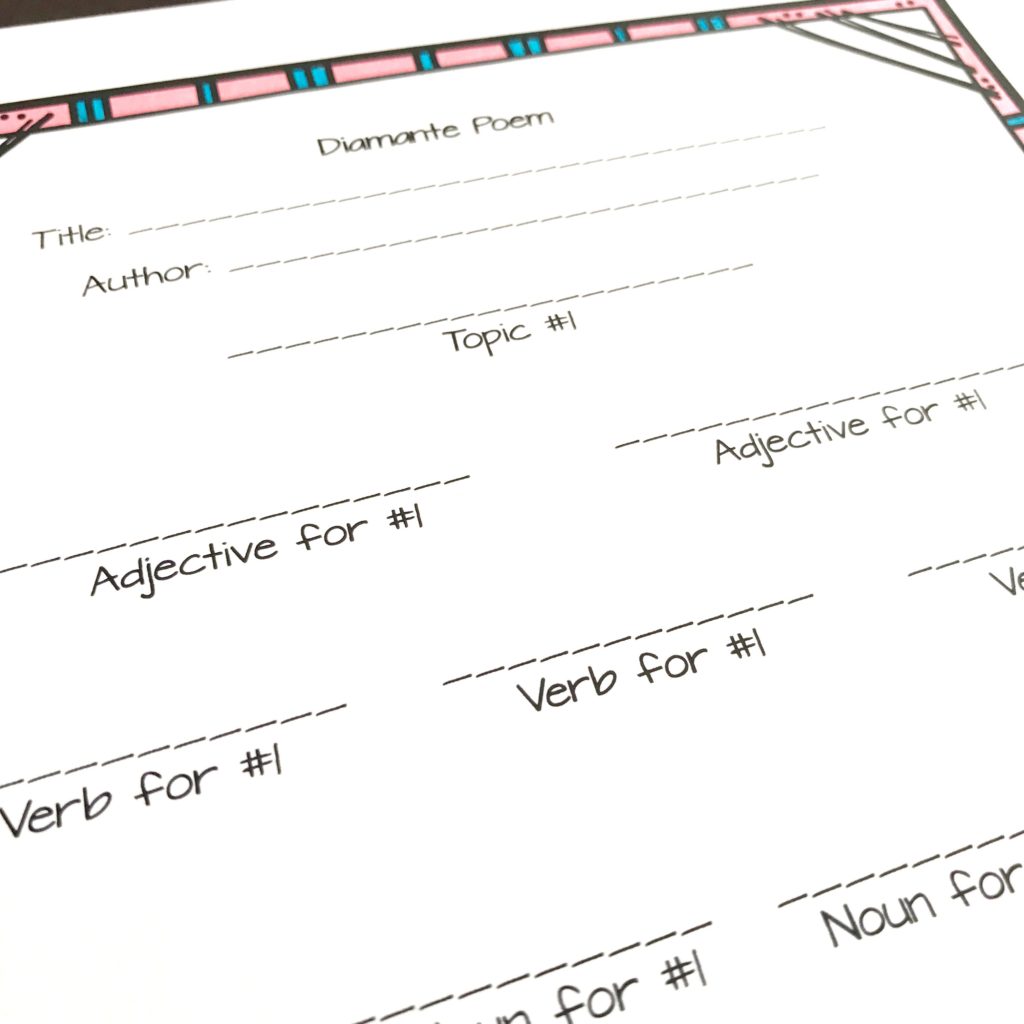

poetry templates
Integrate Other Subjects:
Poetry doesn’t have to be limited to just literacy lessons. You can easily integrate poetry into the content areas. For example, in math you can write diamante poems about the different operations, bio poems about shapes, and acrostics for key vocabulary terms.  You can get plenty of suggestions in this
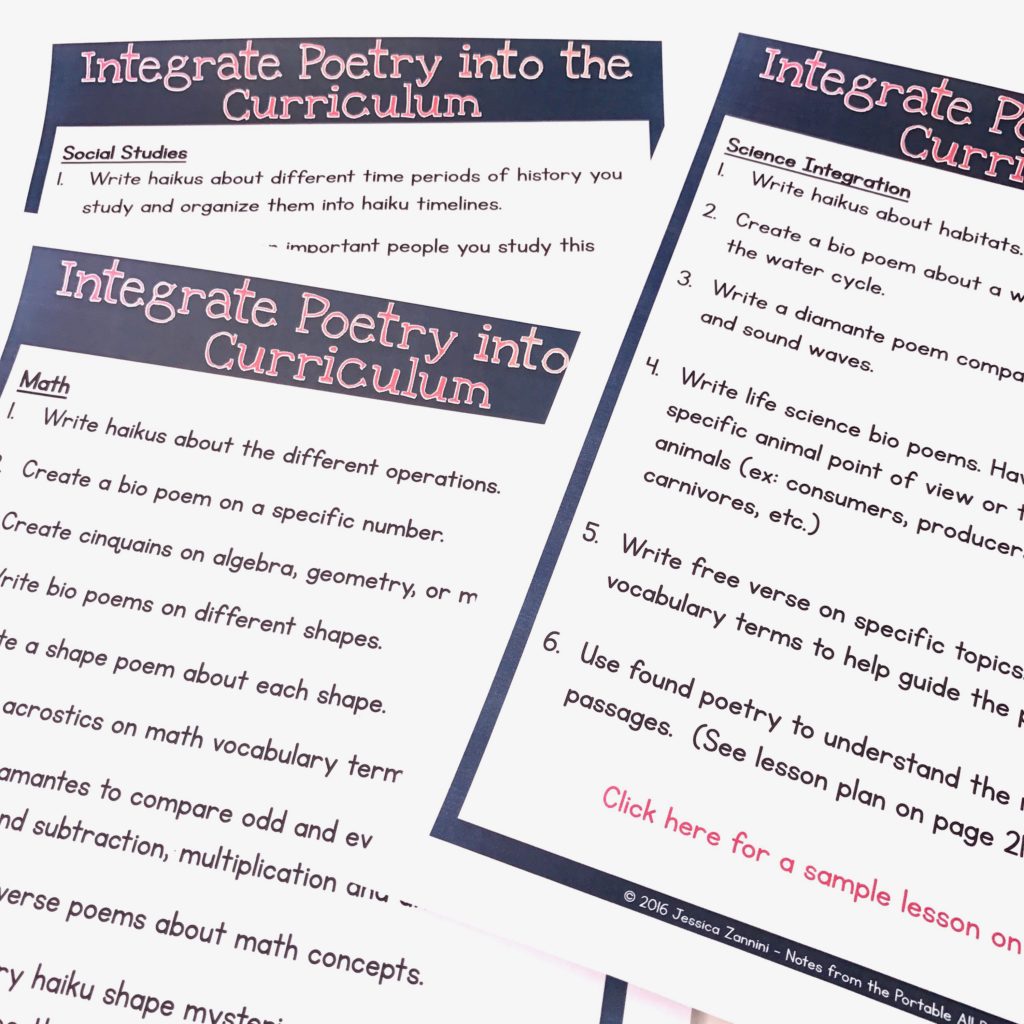

Integrate poetry ideas
Use Close Reads
A poetry close read can help readers make inferences and connections. This simple close read guide can be used with any poem. The questions guide readers to understanding the parts of poetry, identify key terms, and search for main idea.
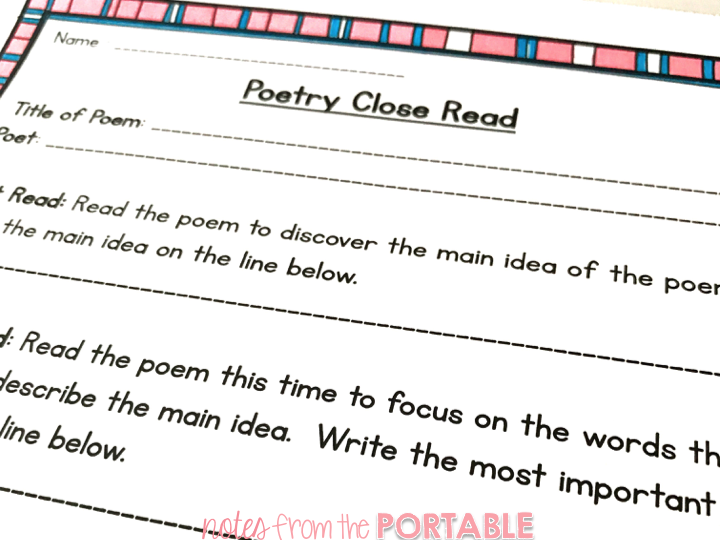

Poetry Close Read for Any Poem
Use Poetry in Lessons and Centers
Make poetry part of your guided reading lessons and literacy centers. Keep it up and running with a poetry book basket and the poetry close read.  Want poetry book suggestions?


Do you want poetry literacy centers that are already prepared?  These monthly poems will allow for you to cover all holidays and seasonal themes. A test-prep/close read guide, written response, poetry writing lesson, and content area connection is provided for each poem.
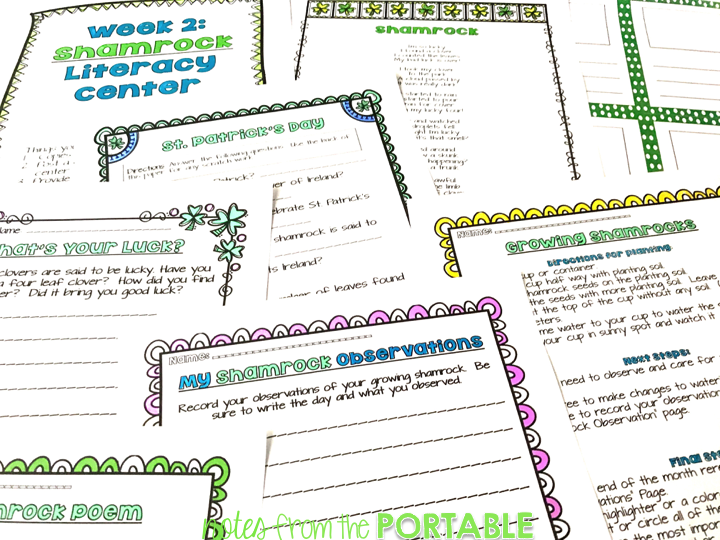

March Poetry Literacy Center
Read Poetry During Read Aloud Time
Use poetry as part of your daily read aloud. Poetry is perfect for read alouds especially on those days when you are running short on time.  Check out this article to get suggestions of poems that will keep your students reading poetry all year long. Each month includes a FREE set of questions and activities.


Found Poetry
Use found poetry to help students identify the main idea of a passage. Have students highlight the important words and phrases as they read. Then cut out the highlighted words and organize them into a poem.
Found Poetry


Create a Wall Display
Keeping up a poetry word wall is a great way to help students learn those important terms. Put it up near your literacy center.  This poetry word wall has terms and examples.  You can color to meet your classroom decor or for student notebooks.  Or just print and go.
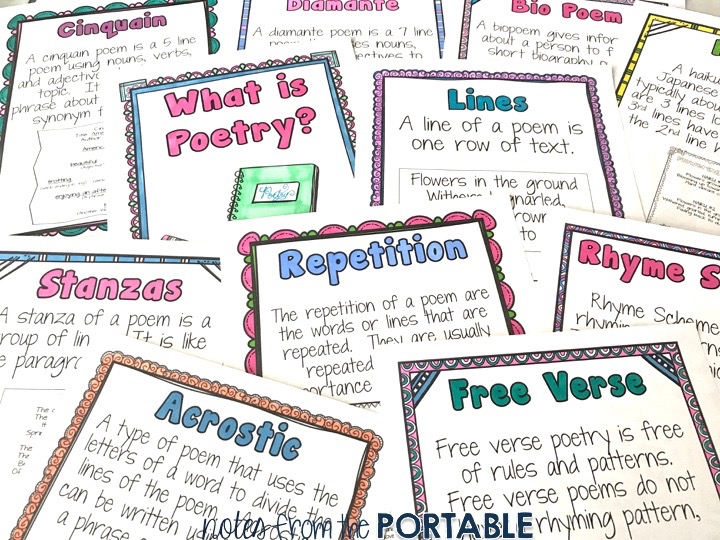

poetry word wall


Want to save this article?  Pin this!


Thursday, April 21, 2016

Spring into April - The Important Thing for Test Review


Hullo! Gary here from ScrappyGuy Designs. I get to write today's post for the Primary Peach. Good times, good times.

When I heard that it was for National Poetry Month, I started scratching my head. My brain is so full of stress Standardized Testing that it took me a bit to wrap my brain around turning to poetry. Then it hit me. Why not create poems for test review?


Fun, right? A perfect way to get the students to think back to material we've covered this year, especially in Social Studies and Science. It would require them to look carefully through their notes and come up with pertinent information to create a poetry piece.


I love using Margaret Wise Brown's book, The Important Book, as a  mentor text in my poetry unit. Her poems use a simple structure that the students can recreate with almost any topic. She starts off with a main idea sentence :

The important thing about a daisy is that it is white.

Then she lists a few details about the flower, or spoon, or rain. Then she repeats the main idea sentence again:

But the important thing about a daisy is that is it white.


Students love using this format and apply it to the various topics  we've studied this year.

Here's one I use with them about grass:

You can let them get crazy with the fonts, color, sizing, and stuff to really show off their creativity.


Here is one of the poems past students have created using our academic content:


The Important Thing about Ferdinand Magellan   By: Mike Lagat


The important thing about Ferdinand Magellan

is that he discovered the Philippine Islands.

He went to Spain to get boats.

He named an ocean the Pacific [Peaceful].

His crew traveled around the world.

So, the important thing about Ferdinand Magellan is that he discovered the Philippines Islands.


Wednesday, April 20, 2016

Spring into April - Using Found Poetry to Dig Up Main Idea


One of my favorite ways to have students connect with a passage or story is through found poetry. With found poetry students can identify the main idea and supporting details in a text.

Found poetry takes specific words and phrases from a piece of writing and organizes them into a poem.  This can be done numerous ways. Students can highlight or underline on a page that is copied. If the text can't be copied (such as a textbook)  students can lightly underline the words/phrases with a pencil (they can erase these marks when the lesson is complete).


Once the words or phrases are chosen, the students will cut or write the words.


Students will then organize the words into a poem. The poem will usually be a free verse poem.  


----------------------------------------------------------------------------------------------
Sample Lesson Plan
Essential Question: What is the main idea? 
Objective: Students will create a found poem using the important words and phrases from a reading passage. 
Standards: RL.1.1, 2.1. 3.1, 4.1, 5.1 

Procedure
1. Introduce the topic: "Today we are going to go on a dive to see if we can find some poetry. Everyone put on your scuba gear, grab your pencils, and let's go swim with the sharks!"
2. Read this Bull Shark Passage. (Just click to access the FREE download) 
3. Read the passage as a whole group, in partners, or independently depending on the level and purpose of your lesson.  Tell students to read for the purpose of learning the most important thing(s) about Bull Sharks. 
4. Then have the students reread the passage.  Have them underline or highlight the words/phrases they feel are the most important or those words really stand out to them.  
5. Students will cut out or write the words they chose.  
6. The words will be organized into a poem (free verse is typically the easiest for this lesson) 
7. Have an Author's Share.  I usually start with 2-3 students and then have the class break into smaller groups to ensure that all students get to share.  If you want to learn more about author's share time, read this post.  

Assessment
Ticket Out the Door - What is the most important thing you learned about Bull Sharks? 
-------------------------------------------------------------------------------------------------
Here is the poem I wrote. 

Bull Sharks
By: Jessica Zannini

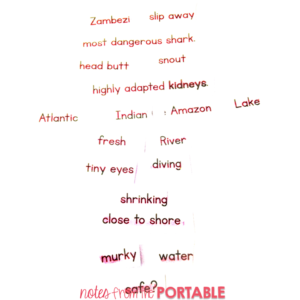
Zambezi, Slip-away
most dangerous shark 
head-butt snout
highly adapted kidneys
Atlantic, Indian, Amazon lake
fresh river
tiny eyes diving
shrinking
close to shore
murky water
safe? 

Looking for more ways to teach poetry?  Check out these posts:


You can also follow this Teaching Poetry Pinterest Board for more engaging poetry ideas.  


Monday, April 11, 2016

Spring into April- Four Free Poetry Apps

Hello Friends! It's Erin from The Elementary Darling, and my peachy friends and I are sharing our favorite new ideas to get you through the month of April!


Today I am here to share four of my favorite FREE poetry apps!


I teach first grade and I was searching for the perfect app for younger students to learn about poetry. Thankfully, I came across these wonderful apps from http://www.readwritethink.org/. They are available for ipad and android so they are perfect for any device. What I like about them is the fact that they are easy for the students to use and the app organizes the poem for the student!

1. Haiku

This app reminds the students to count the syllables, and provides a space for them to brainstorm words.

2. Acrostic Poems

This app provides the student with an example of  an acrostic poem. It then leads them through a brainstorming session, and gives hint words for the acrostic poem.


3. Theme Poem

The theme poem app provides the students with different shapes. The shapes include sports, school, and other kid friendly shapes. The students choose a shape and describe that shape.


4. Diamante 

This app also describes what a diamante poem is and takes the students through the steps to create a diamante poem. It even labels each line and what the student should include in the poem.


All of these apps allow you to save them to the ipad, which would make them easy to save to your computer and print or email! This way, if you only have one device , the students could use this as a center or with a partner! Another great resource for poetry apps is this post from Erintegration! 

Stay tuned for more ideas this month from the Peach! And if you try any of these fabulous FREE apps, let me know!

For even more ideas from The Primary Peach, be sure to follow us on InstagramPinterestand Facebook to catch all the latest news and updates!


Tuesday, April 5, 2016

Spring Into April: Poetry Slam


Happy April, peaches! It's Kristin from School and the City. 

As you know, April is poetry month. What better way is there to celebrate poetry month than by having a poetry slam?


I think kids are more motivated to work when they have something to work for, especially when it comes to writing. We all have kids who aren't avid writers, so it's up to us teachers to facilitate a love for writing by giving them a reason to write!

Most kids do love poetry units and writing poetry, because poetry in itself is just so much fun. But why not make it more fun, and more motivating for all students, by ending your unit by allowing your students to participate in a poetry slam?! Having poetry slam can be as simple or as complicated as you want it to be; It's totally up to you! 


POETRY SLAM MUSTS:

  • Students must have poetry written and prepared to share (duh)
  • Teach the kids how to be good audience members and how to snap. 
  • Encourage the students to dress artistically, in all black. 
  • Show students videos of people reading / reciting poetry so they can study and mimic verbal and facial expressions. 

IF YOU WANT TO GO ALL OUT...

  • Set the stage! Turn the lights down, gather some lamps, and set the mood. 
  • Turn it into a café by providing food or allowing kids to bring snacks. 
  • Invite parents, other students, and/or other staff members. (Hint: Inviting admin may or may not earn you brownie points!)
  • Find a karaoke machine or some sort of sound system to use so everyone can hear.

CLICK the picture to check out my editable invitations!

Last year, my students worked extremely hard all month creating poetry books using my templates and adding their own pages. They turned out to be great little poets! I can't wait to see how my class does this year. 

What do you think? Will you host a poetry slam for your students? Let me know over at School and the City if you try it!


Have a great April in your classroom... and stay tuned for more April ideas!

For even more ideas from The Primary Peach, be sure to follow us on InstagramPinterest, and Facebook to catch all the latest news and updates!


Sunday, April 3, 2016

Spring Into April: Poetry Read-Alouds

Well, hello there, April! It's Theresa from True Life I'm a Teacher!

I'm so excited to kick off the month of April here at The Primary Peach! We're "Digging Up New Ideas" this month! You'll want to check back each day for something new! Plus...it's our 1 Year Blogiversary, and you aren't going to want to miss what we have in store to celebrate!

You can check out my post from last month, all about how to make the most of the ERASERS in your classroom!

April is National Poetry Month!
Poems are an awesome way to help students with fluency! Plus, they're just plain fun!

Over the years, I've collected books that feature lots of poems that are perfect for kids! Most are pretty weird (I'm looking at you Shel Silverstein and Jack Prelutsky), but my kids LOVE them!

If you're not already incorporating poems into your day, start by just reading one or two during your morning meeting. Or, read one when you realize you have don't have enough time to really start anything new, but just enough time for a revolt to happen (that's 2 minutes, in case you were wondering).

If you aren't really sure where to begin, and you don't have a lot of time - you can't go wrong with Where the Sidewalk Ends by Shel Silverstein. I read it as a kid, my fourth grade teacher read it to us, and I love reading the poems to my class.

You (and your students) will LOVE:
- Sarah Cynthia Sylvia Stout Would Not Take the Garbage Out
- Smart
- Sick
- Listen to the Mustn'ts

Jack Prelutsky is another author who has LOTS of books filled with poems your students will get a kick out of.

Looking for something different? Here are my FAVORITE poetry books!
You can find a complete list here.

Be sure to check back each day, with something new from The Primary Peach Authors!
Want to pin this ideas for later? Just use the image below!
For even more ideas from The Primary Peach, be sure to follow us on InstagramPinterest, and Facebook to catch all the latest news and updates!

Friday, February 12, 2016

Sweet Treats: A Fluency Freebie!

A few years ago, I had a group of kiddos who really struggled with reading fluency. I had so many kids working on it as a personal reading goal that I decided to tackle it whole class for awhile.

Best. Decision. Ever. :)

Now, it took a good bit of planning on my part. I spent lots of time on the weekend gathering texts and making it look appealing to my 3rd graders - but I like that stuff. :)

My goal each week was to find 3-4 poems (or short pieces of prose) that students could choose from. This gave me an opportunity to bring in seasonal and high-interest text to my classroom.


The kids chose a new poem each Monday after we read all of the choices aloud together as a class. We were able to build a fluency routine into our everyday Reader's Workshop/Daily 5 Mash-Up, but I'll have to save that for another post. :) However, I will say that throughout the week they had lots of opportunities to practice their poems both inside and outside of school. And, because they chose their pieces each week, they were way more engaged in the practice process than I saw when they were working on our Reading A-Z passages. (Nothing against those - I still use them! I just noticed a BIG difference in their interest in the fluency material.


https://www.teacherspayteachers.com/Product/Presidents-Day-Fluency-FREEBIE-2383611

I'd love to share a set of poems I collected for a week in February. I didn't write any of these poems, but they are published "out there" on the web and I've given credit in the packet where credit is due. I'm working on a few sets of my own poems with a few more bonus features I have up my sleeve. :)


Our theme for this particular week was Presidents' Day, and I actually had a student come back last year and ask for a copy of the "Lincoln Rap" I'm including in this set. She wanted to use it for a speaking and listening project she had and I loved that she remembered it.


This freebie pack also includes a fluency rubric you could use for lots of different speaking and listening activities!
https://www.teacherspayteachers.com/Product/Presidents-Day-Fluency-FREEBIE-2383611


If you'd like to grab a copy of these poems for your own classroom, click here or on any of the pictures above.

Thanks for joining me here at The Primary Peach! I hope you're enjoying our Sweet Treats series! Keep checking back all month long for more February goodies! If you're looking for even more fabulous ideas from The Primary Peach, be sure to follow us on InstagramPinterest, and Facebook to catch all the latest news and updates!